
The Uninvited Predator: Inside the $53B PayPal Raid
Since Feb. 4, our thesis has delivered a 42.68% return vs. 9.27% for the S&P 500. Inside today's cash proposal.

The $53 Billion Vindication
The retail market reacts; the institutional collective rationalizes; but the private predator operates on purely cold arithmetic.
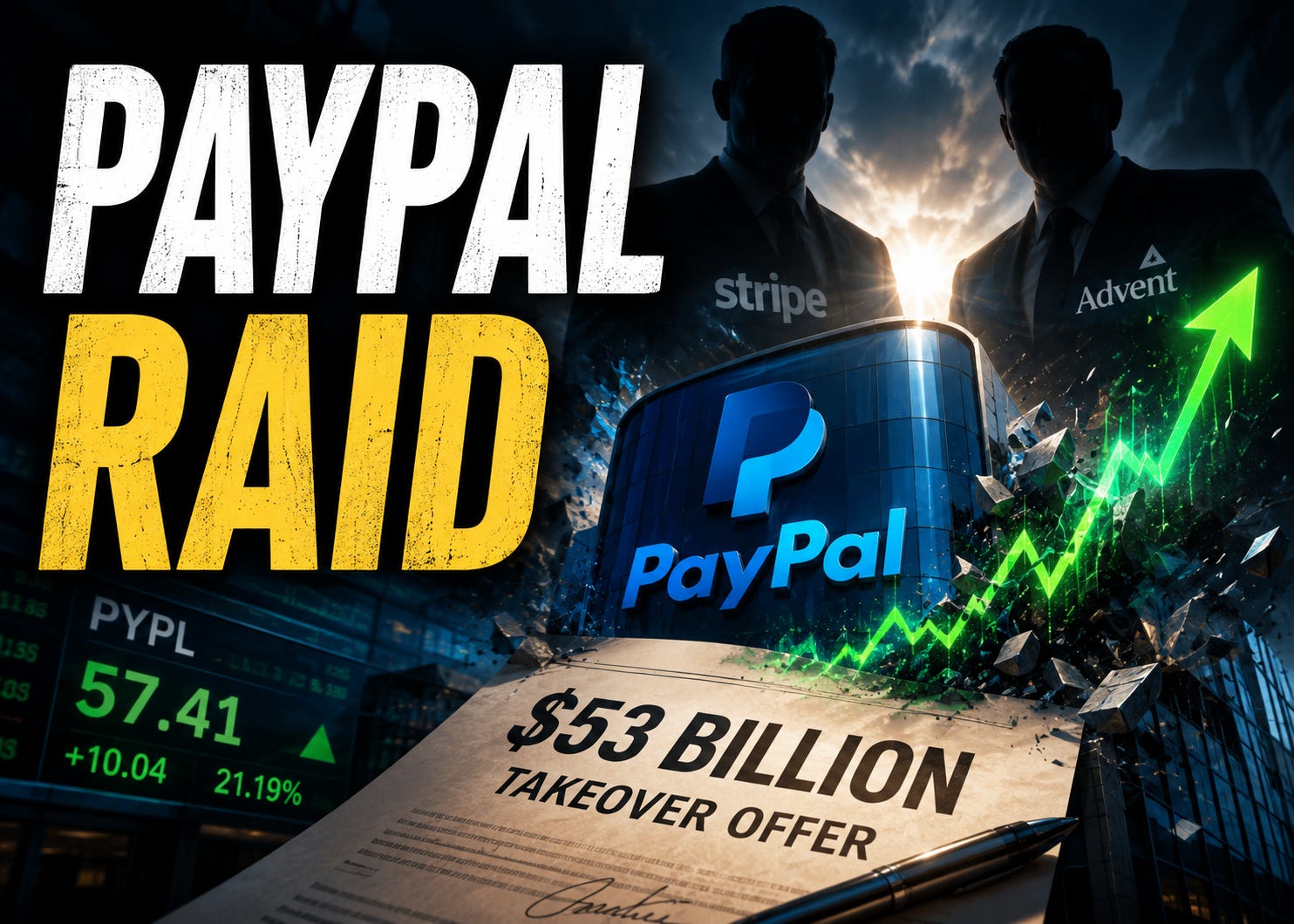
This morning, Reuters broke the news that digital payments powerhouse Stripe has teamed up with private equity giant Advent International to submit a joint takeover bid for PayPal Holdings (NASDAQ: PYPL). The details of the uninvited proposal are staggering:
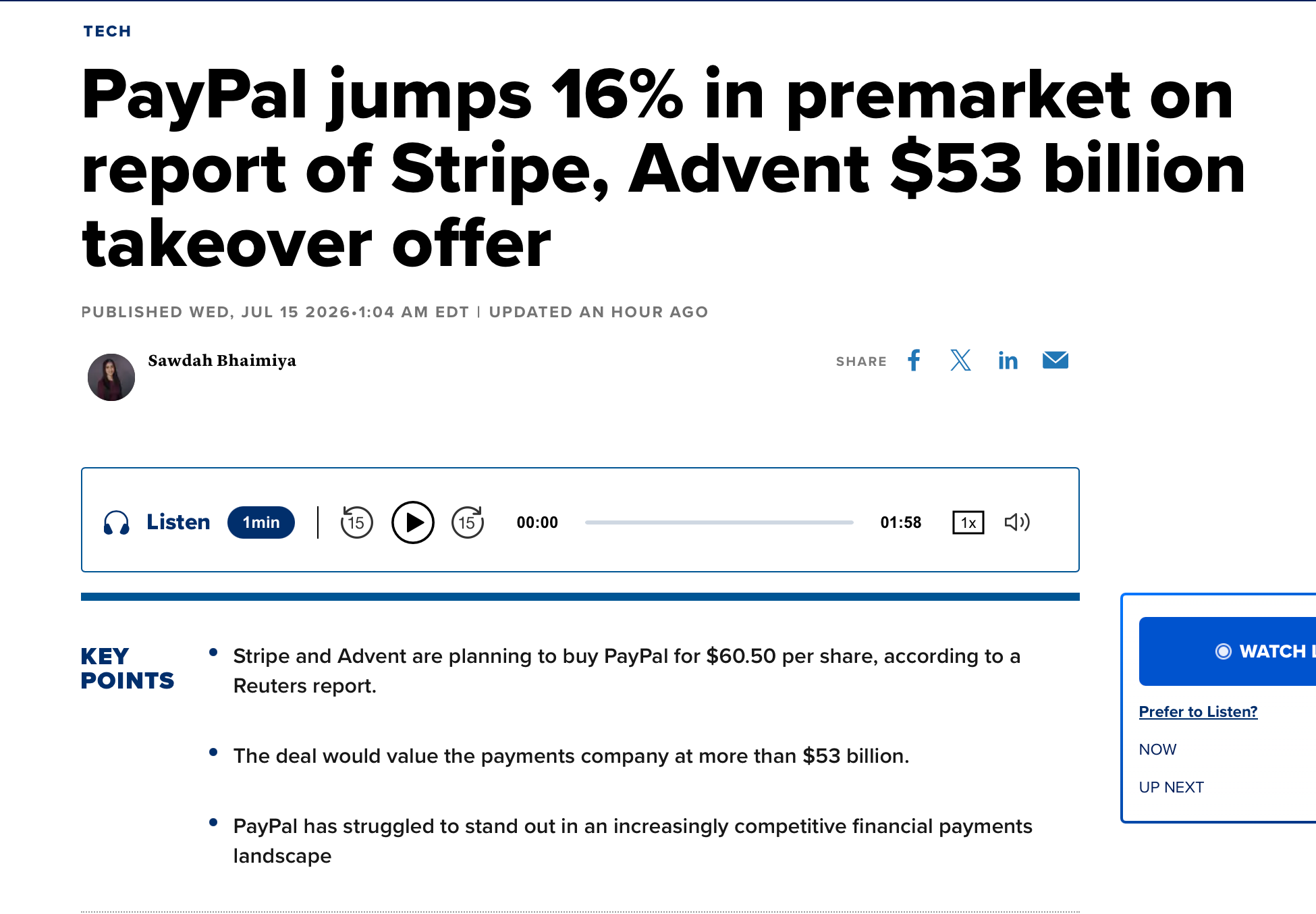
The Offer: $60.50 per share in cash, valuing the digital payment pioneer at more than $53 billion.
The Premium: A massive 28% premium over yesterday’s closing price.
The Funding: Backed by $50 billion in rock-solid, committed bank financing.
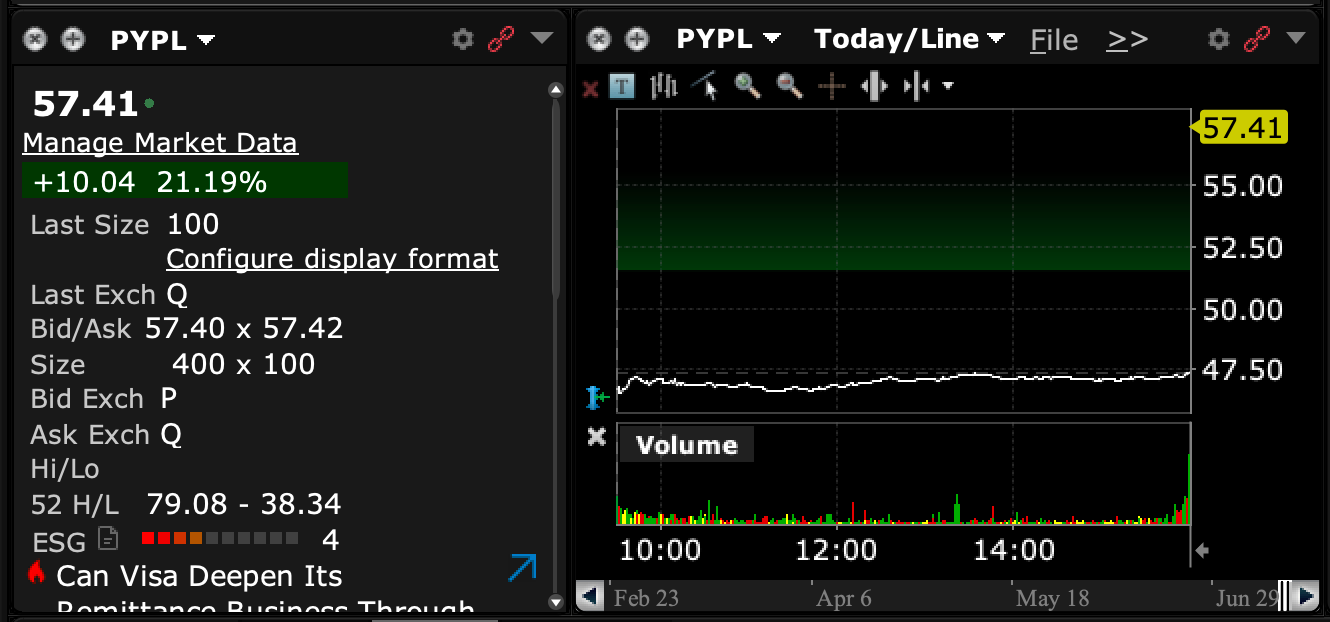
The public equity market, predictably left flat-footed, scrambled at the opening bell. Shares of PYPL instantly gapped upward, surging over 21% in early trading to cross $57.41.
For readers of Against The World, this isn’t market chaos. It is a mathematical certainty playing out exactly as mapped.
Anatomy of Prescience: The 161-Day Disconnect
When we first published our deep-dive analysis on February 4 (“The $12 Billion Disconnect: A Forensic Autopsy of Idea #17”), the consensus view of Wall Street was universally apocalyptic. Driven down by a “kitchen-sink” guidance reset, PayPal’s stock opened that morning at a multi-year low of $40.25.
The institutional “Prosecution,” spearheaded by names like Goldman Sachs and Morgan Stanley, claimed the growth story was fundamentally broken. They focused on shifting narrative metrics while ignoring a cash utility shifting billions through the global economy.
"The institutional crowd is convinced the 'moat' is dry, citing competition and 'perpetual investment cycles'. Yet, they are ignoring a cash-generating engine currently idling at a once-in-a-generation valuation. ... The speculator sells because they fear the next headline. The investor buys because they understand that a $6 billion cash stream, protected by a $2 trillion network, is being handed over at a liquidation price."
- The $12 Billion Disconnect: A Forensic Autopsy of Idea #17
Our original thesis rejected the noise and relied strictly on the Arithmetic of Owner Earnings:
The Valuation Floor: We flagged that PayPal was trading at a trailing P/E of just 8.36x—nearly 80% below its 10-year historical median.
The FCF Yield: It was generating over $6 billion in annual Free Cash Flow, meaning the business was priced like a liquidating asset.
The “Buyback Slingshot”: We highlighted management’s commitment to deploy $6 billion into share repurchases. At those depressed multiples, they were positioned to retire nearly 16% of the float in a single year, creating an massive spring-loaded mechanism for patient capital.
From February 4 to Today: In exactly 161 days, our position has delivered a massive 42.68% return, vastly outpacing the S&P 500’s return of 9.27% over the same timeframe.
The $12 Billion Disconnect: A Forensic Autopsy of Idea #17

In about 11 weeeks, you have pushed this publication to #58 on the global leaderboard in our category (there are 50,000+ publishers on Substack). Thank You.
Why Private Equity Stepped in Where Wall Street Fled
The irony of today’s acquisition bid is that Stripe and Advent are aiming to keep the digital payment network completely intact. They don’t want to break it apart; they want to run it. Why? Because a network processing $2 trillion in annual volume across hundreds of millions of active accounts cannot be replicated, no matter how out of favor it falls with momentum-chasing asset managers.
This marks the third time out of our investment deep-dives that a company flagged as heavily mispriced has become an explicit acquisition target, following the exact footprints of Walgreens and Big Five Sporting Goods.
The Verdict
Even with this morning’s 21% gap up, the market continues to trade below the $60.50 offer price, signaling that public markets are still trying to price in regulatory friction and the reality of a new turnaround strategy under CEO Enrique Lores.
However, our appraisal of intrinsic value remains anchored at $83.00 per share. Stripe and Advent’s bid proves that smart operators recognized the fire-sale floor. The speculator buys the tape; the intelligent investor buys the cash flow before the rest of the world realizes the floor has been reached.
Disclaimer
The information provided in this article is for educational and informational purposes only and does not constitute investment advice, financial recommendations, or an offer to buy or sell any securities. Past performance is not indicative of future results. Investing involves risks, including the potential loss of principal. Readers should conduct their own research or consult with a licensed financial advisor before making any investment decisions. The views expressed herein are those of the author and do not necessarily reflect the views of any affiliated organizations.
Disclosure: Long PYPL